Most Christians know Jeremiah. Far fewer know the man who stood beside him with ink, scroll, courage, and obedience.
His name was Baruch son of Neriah. In the book of Jeremiah, Baruch served as Jeremiah's scribe, writing down prophetic words that powerful people did not want to hear. In the Book of Baruch, his name becomes attached to a short but powerful writing shaped around one of the darkest wounds in Israel's memory: exile.
Jerusalem had fallen. The temple had been destroyed. God's people were scattered. The question underneath the whole book is painfully human: What do faithful people do when their world collapses and they cannot pretend everything is fine?
Baruch does not answer with slogans. It answers with repentance, wisdom, and hope. That is why this overlooked book still matters today.
What Is the Book of Baruch?
The Book of Baruch is a short prophetic and wisdom text associated with Baruch, the scribe of Jeremiah. It is preserved in the Ethiopian biblical tradition and is also read in Catholic and Orthodox Christian traditions, though it is not included in most Protestant Bibles.
That canon detail matters, but it is not the most important thing about the book. Baruch is not valuable merely because it is unfamiliar. It is valuable because it teaches readers how to respond to judgment, grief, guilt, and hope without lying to themselves about any of them.
The opening of the book places Baruch in Babylon after the destruction of Jerusalem. The people hear the scroll, weep, fast, pray, and send offerings and a message back toward Jerusalem. The scene is spiritually charged: exiles are trying to face the truth of what has happened while still reaching toward God.
A historical guardrail is needed here. The book is attributed to Baruch and speaks from within the world of Jeremiah and the Babylonian exile. Modern scholarship often treats the book as a later collection or composition shaped around that setting rather than a simple eyewitness diary from Baruch's own hand. That does not weaken the book's message. It simply keeps us honest about the difference between traditional attribution, literary setting, and historical reconstruction.
Why Baruch Begins With Exile
Baruch begins where many people would rather not begin: with consequences.
The book does not pretend that Jerusalem's suffering came from nowhere. It frames exile through the covenant language of Israel's Scriptures. The people have sinned. They have ignored God's voice. They have trusted what could not save them. Now they are living with the wreckage.
That sounds severe to modern ears, but it is also merciful. Baruch refuses to let grief remain vague. Vague grief can turn into bitterness, denial, or despair. Honest grief can become confession. The book teaches that before restoration can be received rightly, truth has to be named clearly.
This is one reason Baruch still speaks. People today also know what it feels like to live after collapse: after family rupture, after moral failure, after public scandal, after loss, after years of ignoring warning signs. Baruch does not flatter the reader. It says: do not rush past the truth. Sit with it long enough to repent.
Repentance in Baruch Is Not Self-Hatred
One of the strongest sections of Baruch is its prayer of confession. The people do not excuse themselves. They do not blame Babylon first. They do not claim that God has been unfair. They acknowledge that they have turned from God and that the disaster they now face has moral meaning.
But the book's repentance is not self-hatred. This distinction is crucial.
Self-hatred says, "I am ruined, and there is no way back." Repentance says, "I have sinned, but God is still righteous, merciful, and able to restore." Baruch teaches the second path. It holds guilt and hope together. That is spiritually mature. It is also much harder than pretending everything is fine.
Modern readers often want mercy without confession or confession without mercy. Baruch refuses both errors. Mercy without confession becomes cheap comfort. Confession without mercy becomes despair. The book calls the people to tell the truth about sin because God's mercy is stronger than the ruin sin has caused.
That lesson is not ancient only. A person can be religious and still avoid repentance. A church can speak about grace and still avoid truth. A family can want healing and still refuse confession. Baruch cuts through that fog. Restoration begins when people stop defending what is destroying them.
Wisdom in Baruch Is More Than Intelligence
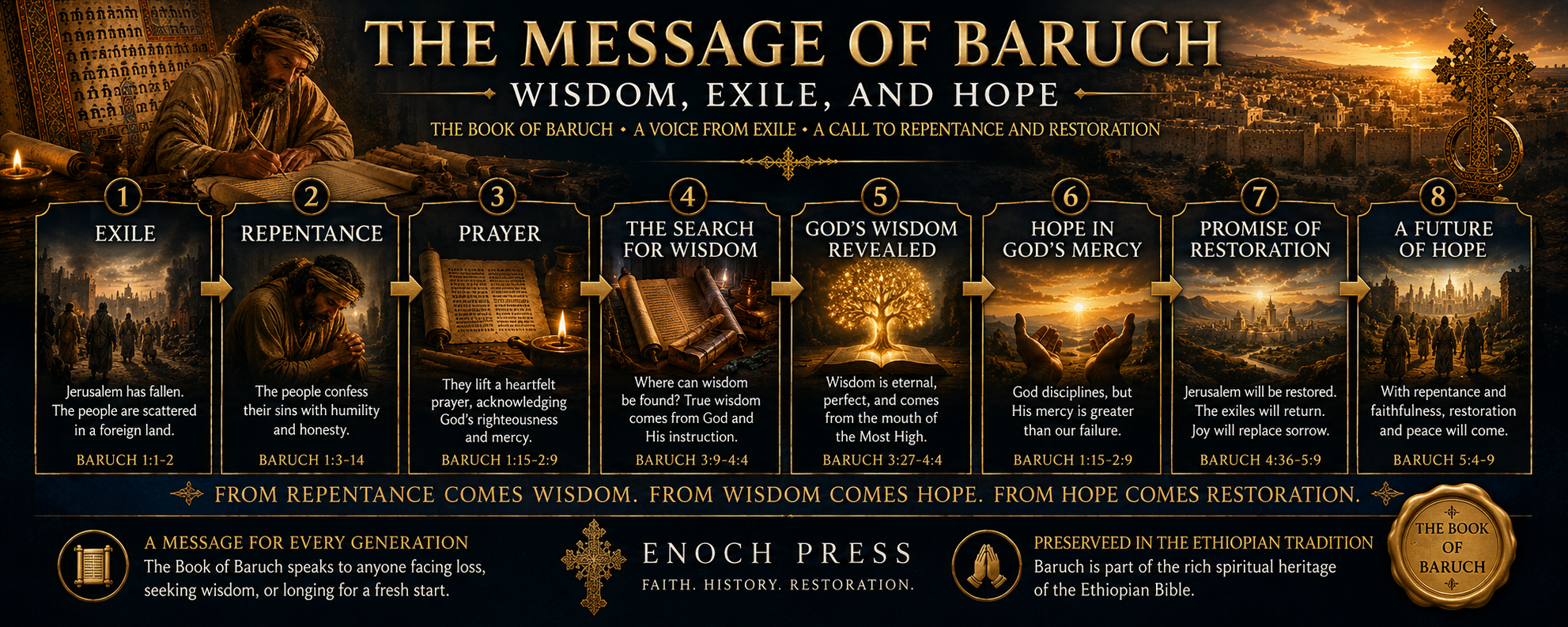
After confession and prayer, Baruch turns toward wisdom. This is one of the most beautiful movements in the book. The question shifts from "How did we get here?" to "Where is the path of life now?"
Baruch's answer is not cleverness, status, or human achievement. The wisdom poem points the reader back to God's instruction. Wisdom is not presented as a private spiritual mood or a collection of impressive ideas. It is the way of life God gives to His people.
That matters because exile is not only geographical. Exile can also be moral and spiritual. A person can be surrounded by opportunities and still be lost. A nation can have wealth and still lack wisdom. A church can have activity and still drift from obedience.
Baruch teaches that wisdom is not the same thing as being informed. We live in an age with endless information and very little formation. People can research everything and obey nothing. They can collect opinions, quote experts, and still lack the humility to walk in the way of God.
The book's wisdom message is blunt: the path back to life is not found by admiring wisdom from a distance. It is found by returning to God's commandments, receiving God's instruction, and letting truth reshape conduct.
Hope in Baruch Does Not Deny Judgment
The final movement of Baruch turns toward consolation. Jerusalem is pictured as a grieving mother whose children have been taken away, but she is also called to take courage. The book looks toward restoration, return, and the mercy of God.
This hope is not sentimental. Baruch does not say that exile was imaginary or that sin did not matter. It does not erase the pain. It does not minimize the loss. Instead, it insists that judgment is not the final word for God's people.
That is the kind of hope serious believers need. Shallow hope says, "Nothing bad will happen." Biblical hope says, "Even here, God is not finished." Baruch belongs to the second category.
The book teaches that God can restore people who have been humbled. It teaches that grief can become prayer. It teaches that confession can become renewal. It teaches that exile does not have to be the end of the story.
For modern Christians, this matters deeply. Many people are not suffering because of one dramatic catastrophe. They are living with layered discouragement: spiritual dryness, cultural confusion, unanswered prayer, church disappointment, family strain, private regret. Baruch gives language for that place. It does not offer a shortcut out of pain. It gives a faithful way through it.
Why Baruch Belongs in the Enoch Press Conversation
Enoch Press exists to help readers explore the wider world of biblical tradition with reverence and historical honesty. Baruch belongs in that conversation because it is both familiar and unfamiliar.
It is familiar because its themes are deeply biblical: sin, repentance, wisdom, mercy, exile, restoration, and hope. Readers who know Jeremiah, Lamentations, Deuteronomy, Proverbs, and Isaiah will recognize the spiritual world Baruch inhabits.
It is unfamiliar because many Christians have never read it, and some have never heard of it. The Ethiopian Bible preserves Baruch within a broader canon that challenges Western readers to remember that the history of Christian Scripture is wider than the Bible table of contents they inherited.
This does not mean every reader must flatten canonical differences or pretend all churches receive Baruch in the same way. They do not. Protestant, Catholic, Orthodox, and Ethiopian Orthodox traditions have different canonical boundaries. But learning about Baruch can still deepen a Christian's understanding of exile, repentance, and hope.
The goal is not to use Baruch as a novelty. The goal is to listen carefully to what this preserved witness teaches.
The Five Messages of Baruch for Today
First, Baruch teaches that grief should be brought before God, not hidden under religious performance. The exiles weep, fast, pray, and respond. They do not act strong for appearance's sake.
Second, Baruch teaches that repentance is a form of truth-telling. The book does not treat confession as humiliation for its own sake. Confession clears the ground for mercy.
Third, Baruch teaches that wisdom must become obedience. It is not enough to admire the law of God or speak warmly about ancient wisdom. The wise path must be walked.
Fourth, Baruch teaches that idolatry is foolish because created things cannot carry ultimate trust. In versions that include the Letter of Jeremiah as chapter 6, this anti-idolatry warning becomes especially direct. The idols of the nations may look impressive, but they cannot save.
Fifth, Baruch teaches that hope is strongest when it has passed through truth. The book's hope is not denial. It is confidence that God can restore what judgment and exile have exposed.
What Baruch Does Not Teach
A serious article also has to say what Baruch does not teach.
Baruch does not teach that every personal hardship is a direct punishment for a specific sin. That would be a lazy and harmful application. The book is dealing with Israel's covenant story and the theological meaning of exile. Modern readers should apply its themes with humility, not recklessness.
Baruch does not teach cheap restoration. The movement from confession to hope passes through sorrow, prayer, and wisdom. If we skip those steps, we are not following the book's logic. We are only borrowing its comfort.
Baruch does not exist to create online arguments about which Bible is the "real" Bible. That framing is tired and unhelpful. The better question is not, "How can I use this book to win a canon debate?" The better question is, "What does this book teach me about returning to God?"
That is where Baruch has power. It pushes the reader away from shallow curiosity and toward actual spiritual examination.
Why Baruch Still Matters
Baruch still matters because Christians still need to learn how to repent without despair, seek wisdom without pride, and hope without denial.
That combination is rare. Many people can do one part. They can confess sin but lose hope. They can speak of hope but avoid repentance. They can admire wisdom but refuse obedience. Baruch holds the pieces together.
The book says: tell the truth about sin. Return to the wisdom of God. Do not surrender hope while you are still in exile.
That is not a soft message. It is a strong one. It is strong enough for people who have failed. Strong enough for communities that need renewal. Strong enough for believers who feel far from home. Strong enough for readers who are tired of religious language that comforts without confronting and confronts without healing.
Baruch matters because it teaches the soul how to come home.
Conclusion
The Book of Baruch may be short, but it is not shallow. It stands in the shadow of Jerusalem's destruction and teaches God's people how to pray after collapse. It shows that repentance is not the enemy of hope. It shows that wisdom is not detached intelligence but faithful obedience. It shows that exile is painful, but it is not beyond the reach of God's mercy.
For Christians today, Baruch is not merely an ancient text from a wider biblical canon. It is a spiritual diagnostic. It asks whether we are willing to tell the truth, return to wisdom, and trust God for restoration even before the exile is over.
That is why Baruch still matters. It gives language to the broken, correction to the proud, wisdom to the confused, and hope to those who are ready to return.
Reflection
Where have you been asking God for restoration while avoiding confession?
What would repentance look like if you stopped treating it as shame and started receiving it as the doorway back to life?
What wisdom have you admired but not obeyed?
Baruch's message is not complicated: return to God, walk in wisdom, and do not let exile have the final word.